
 About Gaming Mouse

카트
장바구니가 비어있습니다
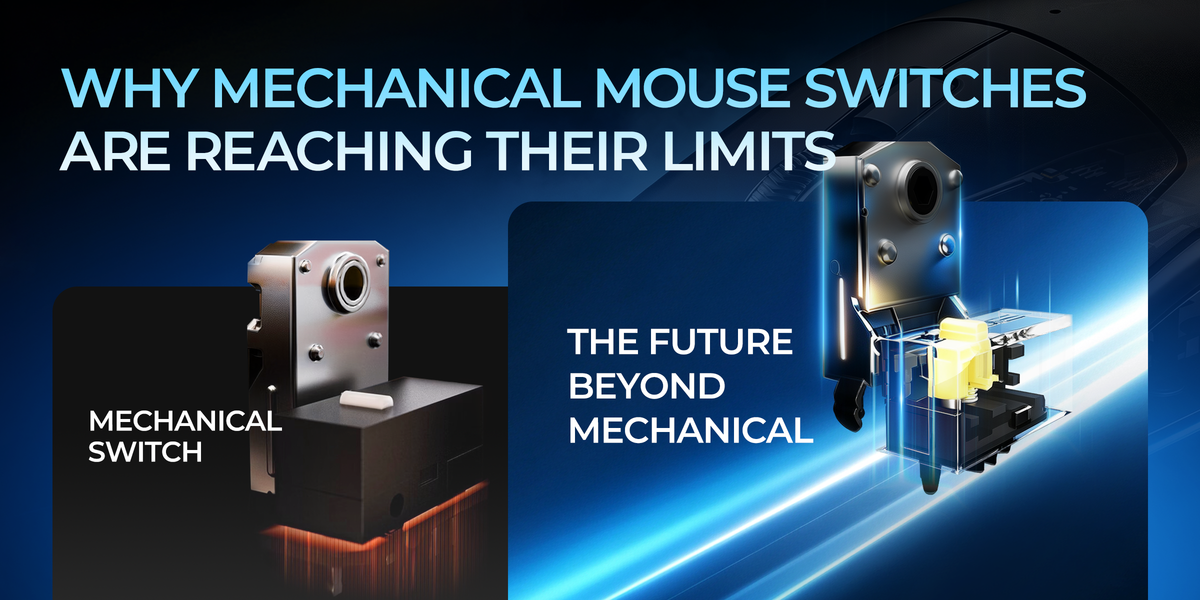
For more than two decades, the mechanical mouse switch has been the foundation of competitive gaming mice. It has helped millions of players build muscle memory, develop precision, and compete at the highest levels. From casual gamers to pro esports athletes, nearly every iconic gaming mouse has relied on the same basic clicking mechanism.
Mechanical switches have served the industry remarkably well. They are responsive, familiar, and relatively inexpensive to manufacture. But as competitive gaming evolves, the demands placed on gaming mice have changed dramatically.
Today's players expect lower latency, higher polling rates, longer durability, and greater consistency than ever before. These expectations are beginning to expose the physical limitations of traditional mechanical switches.
Rather than asking "Which mechanical switch is best?", the industry is starting to ask a different question:
Is the mechanical switch itself becoming the bottleneck?
Although gaming mice have become lighter, sensors have become more accurate, and wireless performance has improved dramatically, the core clicking mechanism inside most gaming mice remains largely unchanged.
Every mechanical switch relies on physical metal contacts.
Every click requires those contacts to touch.
Every release separates them again.
This simple design has proven reliable for years, but it also introduces several unavoidable characteristics:
• Physical wear over time
• Contact bounce
• Debounce processing
• Variations between switches
• Gradual changes in click feel
None of these problems necessarily make a mouse unusable, but together they affect long-term consistency.
For competitive players, consistency matters just as much as raw performance.
One of the most widely discussed issues among gaming mouse users is unintended double-clicking.
Contrary to popular belief, this is not always caused by poor manufacturing quality.
Instead, it is often the result of how mechanical contacts behave after millions of actuations.
As metal contacts age, tiny changes in their surface can alter the electrical signal generated during a click. The mouse firmware must then determine whether it received one click or multiple signals occurring within a very short period of time.
To reduce accidental inputs, manufacturers implement debounce algorithms.
However, debounce introduces a compromise:
• Longer debounce times improve stability.
• Shorter debounce times improve responsiveness.
Finding the perfect balance becomes increasingly difficult as competitive players demand both speed and reliability.
Competitive gaming in 2026 looks very different from a decade ago.
Professional players now commonly use:
• High refresh rate displays
• Extremely low system latency
• High-performance sensors
• Advanced wireless connections
• High polling rates
As every part of the input chain becomes faster, even small inconsistencies become easier to notice.
Players no longer judge a mouse only by its weight or shape.
They pay attention to:
• Click consistency
• Input latency
• Reliability over time
• Confidence during rapid-fire actions
The click itself has become part of the overall performance equation.
Historically, manufacturers competed by increasing DPI or reducing weight.
Today, those improvements alone are no longer enough.
Professional players expect hardware to perform the same on day one as it does months later.
Reliability is no longer just about durability.
It is now a competitive performance feature.
The ability to maintain consistent click characteristics throughout a product's lifespan is becoming increasingly important for esports hardware.
Whenever one technology approaches its practical limits, innovation follows.
Mechanical keyboards gradually evolved into Hall Effect keyboards to improve precision and consistency.
Gaming mice are now entering a similar period of exploration.
Across the industry, engineers are researching new approaches to input detection, alternative sensing methods, improved durability, and lower latency.
The goal is not simply to replace mechanical switches.
The goal is to build input devices that can better meet the demands of modern competitive gaming.
Exactly which technologies will become the future standard remains to be seen.
But one thing is becoming increasingly clear:
Competitive gaming is no longer driven only by faster sensors or lighter shells.
The click itself is becoming an area of innovation.
Gaming hardware has never evolved by standing still.
Each generation of competitive players raises expectations for precision, speed, and consistency.
As those expectations continue to grow, manufacturers will need to rethink every component of the input experience—including the click mechanism itself.
At DrunkDeer, we believe the future of competitive input isn't defined by marketing numbers alone.
It is shaped by engineering, thoughtful design, and a willingness to challenge long-standing assumptions.
In the coming weeks, our Technology Series will explore the next generation of gaming mouse technologies, including latency, polling rates, input consistency, and emerging approaches to click design.
Because the future of competitive gaming isn't just about moving faster.
It's about building input devices that help players perform with greater confidence.
No. Mechanical switches remain highly capable and continue to power many excellent gaming mice. However, increasing performance expectations are encouraging the industry to explore new technologies.
Not necessarily. Product quality, switch design, firmware tuning, and usage habits all influence long-term reliability.
Consistent clicks improve confidence during repeated actions, rapid firing, and long practice sessions where predictable input matters.
Upcoming articles will explore polling rates, latency, wireless performance, gaming mouse design, and the engineering challenges behind next-generation competitive input devices.

