Input Latency: More Than Just Switch Speed
One of the biggest misconceptions in keyboard marketing is that switch technology alone determines latency.
In reality, keyboard latency depends on an entire processing chain:
-
Switch detection
-
MCU processing
-
Firmware optimization
-
USB polling
-
Operating system scheduling
-
Game engine processing
The switch only affects the first step.
A poorly optimized Hall Effect keyboard can perform worse than a well-designed optical keyboard.
Likewise, a premium Hall Effect keyboard with high-quality firmware and a powerful MCU can outperform many optical designs.
Rather than focusing solely on advertised response times, evaluate the entire keyboard platform.
Adjustable Actuation: Hall Effect's Biggest Advantage
Adjustable actuation is one of the defining features of Hall Effect technology.
Traditional and optical switches activate at a fixed point determined during manufacturing.
The Hall Effect keyboards allow users to change that point through software.
For example:
| Key |
Recommended Actuation |
| W A S D |
0.1–0.3 mm |
| Shift |
0.5 mm |
| Ctrl |
0.8 mm |
| Space |
1.0 mm |
| Ability Keys |
1.5–2.0 mm |
This flexibility enables players to optimize different keys for different functions.
Movement keys can respond instantly, while utility keys require deeper presses to prevent accidental activation.
This level of customization is impossible with standard optical switches.
Rapid Trigger: Where Hall Effect Truly Stands Out
Rapid Trigger has become one of the most sought-after features in competitive gaming keyboards.
With traditional switches, a key must return to a fixed reset point before it can activate again.
Hall Effect keyboards remove this limitation.
Because the keyboard continuously tracks key position, it can reset the key the moment it begins moving upward.
Benefits include:
-
Faster counter-strafing
-
Cleaner movement transitions
-
Improved shoulder peeking
-
More responsive directional changes
Some optical keyboards offer firmware-based implementations of Rapid Trigger, but these remain constrained by binary sensing.
Hall Effect technology performs Rapid Trigger naturally because it always knows the exact position of every key.
Analog Input: A New Dimension of Keyboard Control
Another feature unique to Hall Effect technology is analog input.
Optical keyboards operate digitally:
Pressed or not pressed.
Hall Effect keyboards measure continuous travel.
This enables variable input similar to a controller joystick.
Potential applications include:
Although not every game currently supports analog keyboards, adoption continues to grow, making Hall Effect a more future-proof investment.
Durability and Reliability
Both Hall Effect and Optical switches are highly durable because neither relies on electrical contact between metal leaves.
Typical lifespan estimates:
Real-world durability depends not only on switch technology but also on:
A well-built keyboard of either type can provide years of reliable performance.
Gaming Performance Comparison
FPS Games
Examples:
-
Counter-Strike 2
-
Valorant
-
Apex Legends
-
Rainbow Six Siege
Best Choice: Hall Effect
Reasons:
MOBA Games
Examples:
Best Choice: Either
Both technologies provide excellent responsiveness. Adjustable actuation offers less noticeable benefits than in FPS titles.
MMO Games
Examples:
-
World of Warcraft
-
Final Fantasy XIV
Best Choice: Either
Comfort, layout, and software support often matter more than switch technology.
Racing and Simulation Games
Hall Effect has a distinct advantage thanks to analog input capabilities, allowing smoother acceleration and steering in supported titles.
Productivity
For programming, writing, and office work, either technology performs exceptionally well.
Typing feel, keycap profile, and ergonomics generally have a greater impact than switch sensing technology.
Which Keyboard Should You Buy?
Choose a Hall Effect keyboard if you:
-
Play competitive FPS games regularly.
-
Want Rapid Trigger.
-
Need adjustable actuation.
-
Enjoy customizing your keyboard.
-
Want the latest gaming technology.
Choose an Optical keyboard if you:
-
Prefer a traditional digital typing experience.
-
Want excellent gaming performance without extensive customization.
-
Have a tighter budget.
-
Primarily use your keyboard for mixed gaming and productivity.
Frequently Asked Questions
Is Hall Effect faster than Optical?
Not necessarily in raw activation speed. The main advantage lies in advanced features like Rapid Trigger and adjustable actuation rather than lower latency alone.
Can Optical keyboards use Rapid Trigger?
Some manufacturers simulate Rapid Trigger through firmware, but Hall Effect keyboards implement it more naturally using continuous position tracking.
Which technology lasts longer?
Both are highly durable. Overall build quality, firmware support, and manufacturing standards have a greater impact on lifespan than switch technology alone.
Is Hall Effect worth the extra money?
For competitive gamers who will actively use features such as adjustable actuation and Rapid Trigger, the additional investment is often worthwhile.
Do Hall Effect keyboards improve aim?
Not directly.
They improve movement precision, allowing players to stop, strafe, and reposition more consistently, which can indirectly support better shooting accuracy.
Are Optical keyboards obsolete?
No.
Optical keyboards remain an excellent upgrade over traditional mechanical keyboards and continue to offer outstanding gaming performance.
Which is better for esports?
Hall Effect currently offers the most comprehensive feature set for professional and competitive FPS gaming.
Should I upgrade from Mechanical to Hall Effect?
If competitive gaming is your priority, Hall Effect represents one of the most meaningful upgrades available today.
Final Verdict
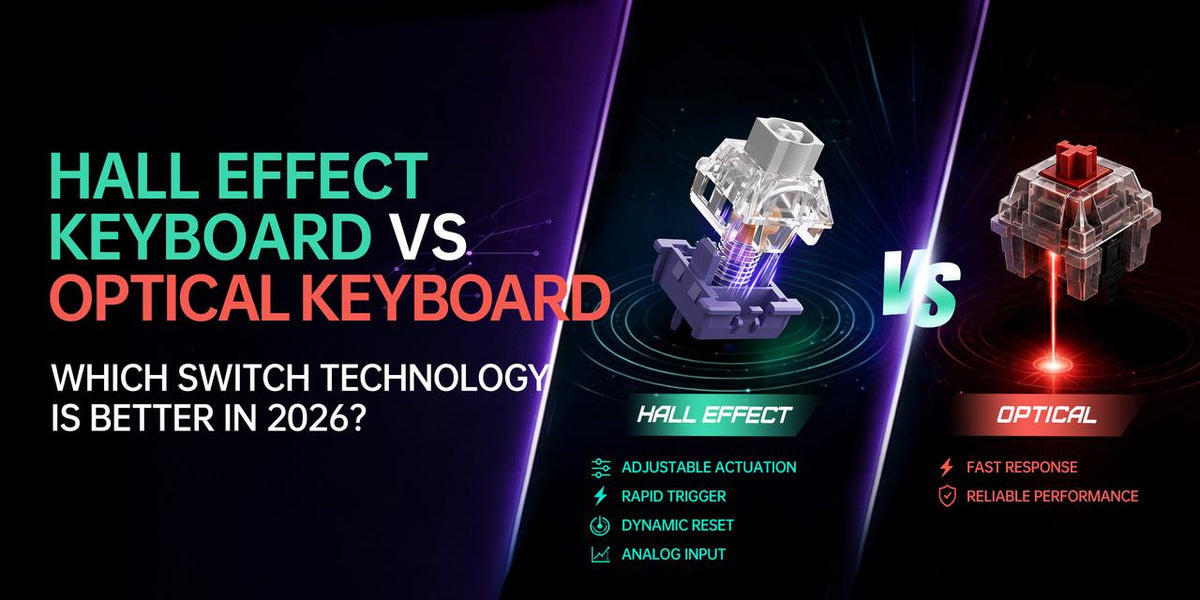
Hall Effect and Optical keyboards are both significant advancements over traditional mechanical designs, but they target different priorities.
Optical keyboards focus on delivering fast, reliable digital activation with minimal maintenance and excellent durability. They are a strong choice for gamers who want responsive performance without extensive configuration.
Hall Effect keyboards build upon those strengths by introducing continuous position sensing. Features such as adjustable actuation, Rapid Trigger, analog input, and per-key customization provide a level of control that traditional digital switches cannot match.
For casual gamers and general users, either technology can deliver an outstanding experience. However, for competitive FPS players seeking maximum precision, flexibility, and future-ready functionality, Hall Effect keyboards currently represent the most advanced option available.
Ultimately, the question isn't simply which keyboard is faster—it's which one gives you the greatest control over every keystroke. In 2026, Hall Effect technology sets the benchmark for that level of precision.
Related Articles
To learn more about Hall Effect technology and competitive gaming performance, continue with these guides:
Explore Further
If you're considering upgrading your gaming setup, look beyond headline specifications such as polling rate or response time. Features like firmware quality, sensor implementation, adjustable actuation, and Rapid Trigger often have a greater impact on real-world performance than marketing numbers alone. Choosing the right keyboard means selecting the technology that best matches the way you play, both today and in the years ahead.

 adjustable trigger magnetic keyboard



 Best Hall Effect gaming keyboard
 Best Hall Effect gaming keyboard